Picture this. You just signed the lease for your new restaurant in T. Nagar. The kitchen equipment is ordered, and opening day is marked on the calendar. Then someone mentions the Fire NOC, and suddenly you’re looking at three different government documents, not sure which one you actually need.
You’re not alone. Most restaurant owners in Chennai learn about fire compliance the hard way, usually right before an inspection, or worse, right after a fire. The good news is that once you understand how the pieces fit together, it’s much simpler than it looks. This guide explains what applies to your kitchen, why a proper kitchen fire suppression system matters, and how to stay compliant without a last-minute rush
Why Chennai Kitchens Get Checked More Closely
A commercial kitchen is not treated like a normal office or shop during a fire inspection. Grease, hot oil, and open flames make it a higher fire risk, so inspectors check it more carefully than the rest of the building.
That’s actually good news for you as an owner. Once you know what inspectors look for, you can prepare ahead of time instead of scrambling at the last minute.
The Three Things You’re Actually Dealing With
Chennai’s fire rules are not just one single rulebook. They come from three sources working together, and once you understand each one, the confusion clears up fast.
- National Building Code (NBC) 2016, Part 4. This is the rulebook. It lists what fire safety should actually look like: how wide your exits should be, where extinguishers go, and what systems your kitchen needs.
- Tamil Nadu Fire Service Act, 1985, and its Rules. This is the law that gives the fire department the power to inspect your kitchen, approve it, and fine you if something is wrong.
- Tamil Nadu Fire and Rescue Services (TNFRS). This is the department that actually comes to your restaurant, checks it, and gives you approval.
Think of NBC as the rulebook, the Act as the law behind it, and TNFRS as the officer who checks your kitchen in person.
What is a Fire NOC?
A Fire NOC (No Objection Certificate) is a document that proves your kitchen’s fire safety equipment, exits, and paperwork meet the rules set by NBC 2016 and the Tamil Nadu Fire Service Act.
It’s not just paperwork you can file away and forget. Your Fire NOC is linked to your building’s occupancy certificate from the Chennai Metropolitan Development Authority (CMDA). This means that if your NOC expires, it can affect your legal right to run your business, not just your fire safety score.
Who Needs One
Bigger commercial buildings, hotels, restaurants, and places where many people gather usually need a Fire NOC. The exact size or height that makes it compulsory can change depending on which TNFRS document you check. Because of this, it’s best to confirm your exact requirement directly with TNFRS or a local fire safety consultant, rather than guessing from any blog post, including this one.
How to Get Your Fire NOC: The Basic Steps
Here’s what the process usually looks like for restaurant owners:
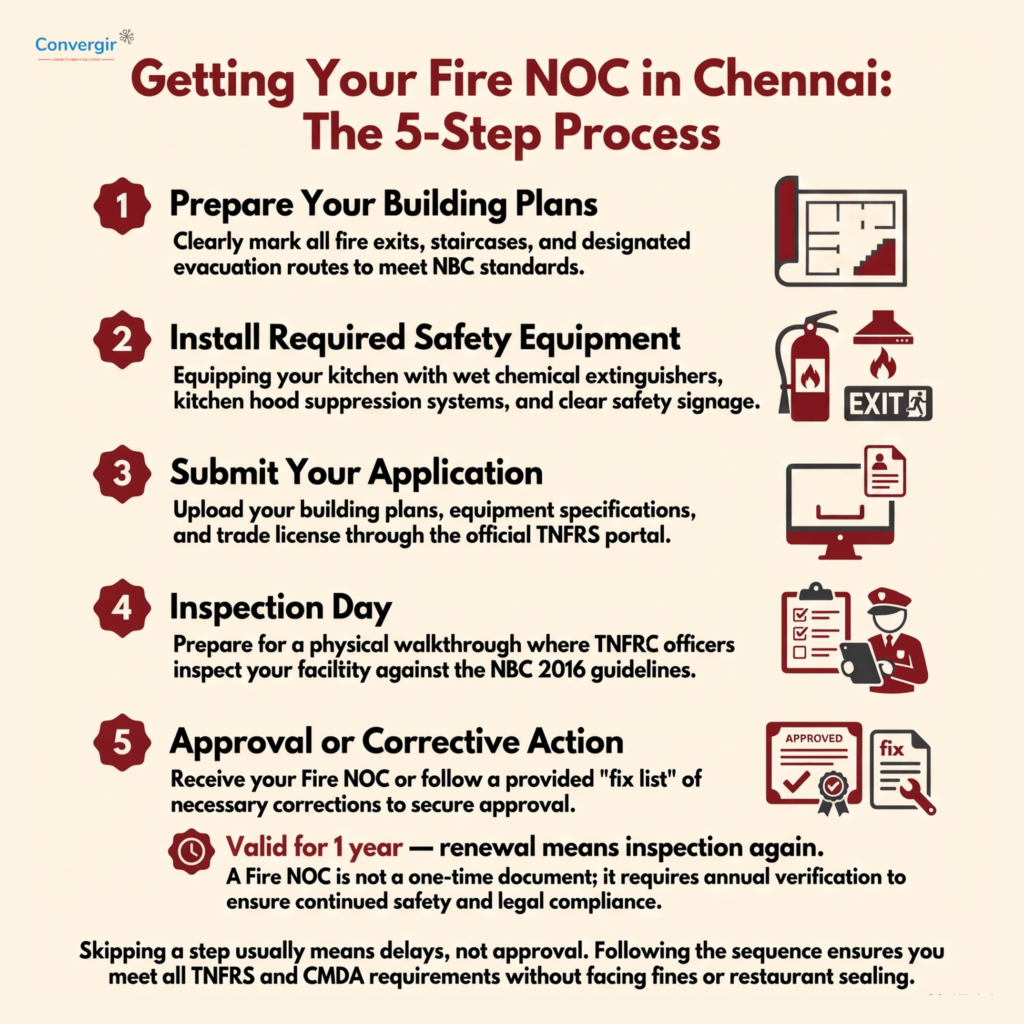
- Prepare building plans that show your fire exits, staircases, and evacuation routes
- Install the required fire safety equipment before your inspection
- Submit your application through the TNFRS portal, along with your building plans, safety equipment details, and trade license
- Let the fire department inspect your restaurant in person
- Get approval, or a list of fixes to make if something doesn’t pass
A Fire NOC usually needs to be renewed every year, and renewal means going through the inspection again. It’s not a one-time paper. It’s something you need to keep up every year.
What Your Kitchen Specifically Needs
This is where general fire safety advice isn’t enough, and kitchen-specific rules matter. A proper kitchen fire suppression system is at the center of this, and here’s what inspectors usually check closely in a commercial kitchen:
- Wet chemical extinguishers made for grease and cooking oil fires. Regular extinguishers are not built to handle this kind of fire.
- Correct placement, usually close to every part of the kitchen and mounted at a height that’s easy to reach, with clear signs marking where they are.
- Clean exhaust ducts, since built-up grease in the ductwork is one of the most common causes of kitchen fires.
- A proper kitchen hood suppression system, working together with your extinguishers, not replacing them.
Missing even one of these is a common reason restaurants fail their first inspection.
What Happens If You Skip It
Running your restaurant without a valid Fire NOC is not a small risk. It can lead to real problems:
- Fines under the Tamil Nadu Fire Service Act
- Authorities sealing your restaurant, meaning you can’t operate
- Personal legal trouble if a fire happens while you’re not compliant
- Your insurance company refusing to pay a claim, since most policies require a valid Fire NOC to stay active
That last point surprises a lot of owners. You can have full insurance coverage and still get nothing if your Fire NOC had already expired when the fire happened.
Why So Many Restaurants Fail Their First Inspection
A few problems come up again and again:
- Paperwork that’s incomplete or based on old building plans
- Wrong type of extinguisher, or extinguishers placed incorrectly
- Blocked or poorly marked exits
- Suppression systems that haven’t been serviced in a while
- Treating the Fire NOC as a one-time task instead of something to renew every year
Most of these problems are easy to fix with a proper check before your inspection, which is exactly what a good fire safety consultant helps with.
Getting It Right From the Start
Fire compliance in Chennai is not something you want to figure out on your own or guess your way through. A local fire safety consultant checks your kitchen against the current NBC and TNFRS rules, recommends the right equipment for your space, and makes sure your paperwork is ready before an inspector arrives.
If you’re opening a new kitchen, renovating an old one, or you’re not sure if your Fire NOC is still valid, don’t wait for an inspection to find out. Contact our team for a compliance check and fire suppression system installation, and we’ll walk you through exactly what NBC, TNFRS, and your Fire NOC require, so you can focus on running your restaurant instead of worrying about your next inspection.
Most commercial kitchens need one, but the exact size or height that makes it compulsory can vary. Check with TNFRS or a local consultant to confirm your specific case.
It depends on how complete your documents are and how quickly the inspection is scheduled. Missing paperwork is the most common reason it takes longer than expected.
A wet chemical extinguisher, since it’s made for grease and cooking oil fires. Regular extinguishers aren’t built to handle this type of fire safely.
Usually once a year, and renewal means going through the inspection again, not just paying a fee.
Yes. Most insurance policies require a valid Fire NOC to stay active. If it’s expired when a fire happens, your claim can be rejected even with full coverage.