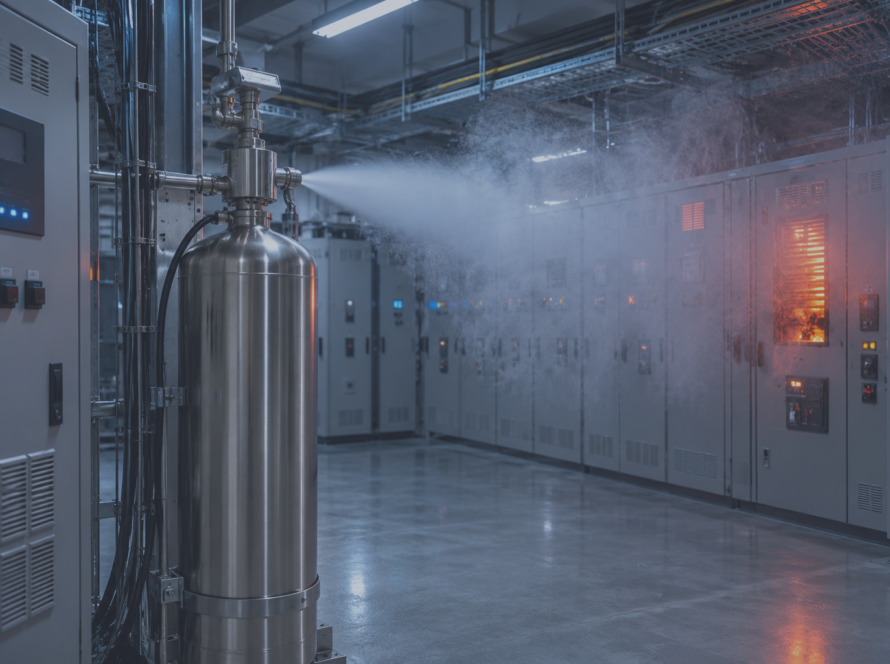
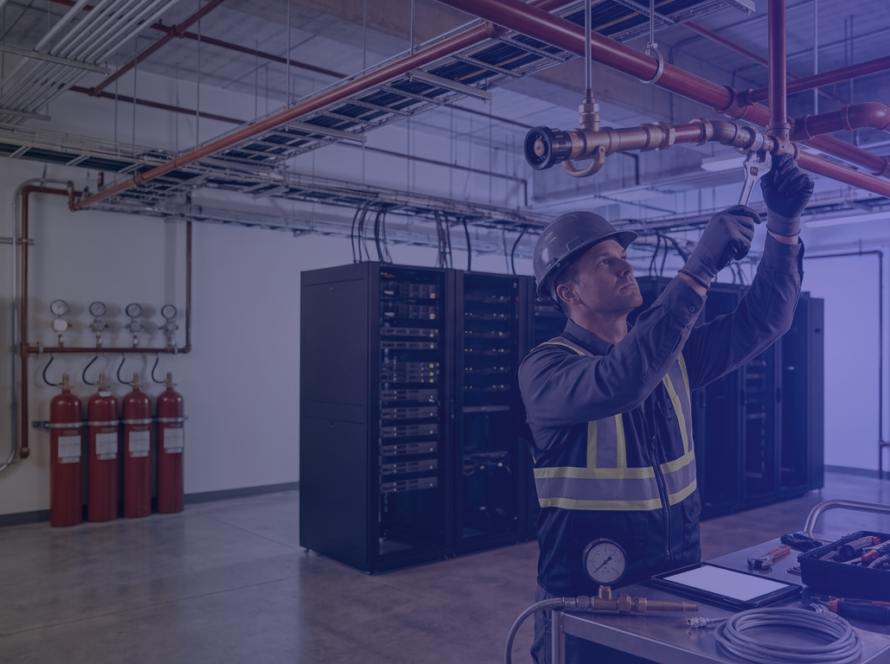
Picture a server room on fire. A sprinkler turns on and the fire stops, but so does every rack, drive, and switch in the room. So the building survives but the data center doesn’t.
That’s the exact problem gas suppression systems solve. In rooms where water damage would cost as much as the fire itself, “just add water” isn’t good enough. This guide explains how gas suppression works, where it’s used instead of sprinklers, and what goes into designing one properly
Why Some Rooms Need Special Protection
Fire codes split protected spaces into two groups: normal spaces, where sprinklers are the default choice, and special rooms, where what’s inside is worth more — or is more sensitive than the water damage a sprinkler would cause.
These special rooms usually include:
- Server rooms and data centers
- Electrical switchgear rooms and LT (low tension) panels
- Telecom and control rooms
- Archives, museums, and record storage
- Emergency generator and transformer rooms
In each case, the reason to avoid water is simple: electronics short out, records get ruined, and wet switchgear often needs full replacement instead of just a clean-up. Gas suppression puts out the fire without causing a second kind of damage.
What “Gas Suppression” Actually Means
The term covers a few different systems, and each one works in its own way:
Clean agent systems (like FM-200 or Novec 1230) release a chemical agent that stops the fire’s chemical reaction and pulls away heat, putting out the fire in seconds without leaving any mess behind. These are the most common pick for rooms with people or electronics, because the agent is safe for brief human exposure and won’t harm equipment.
Inert gas systems (nitrogen, argon, or blends like Inergen) work differently they lower the oxygen level in the room enough to stop the fire, but not so low that it’s immediately dangerous if people leave right away. These systems need bigger cylinder banks than clean agent systems to protect the same size room, which is the main trade-off.
Aerosol suppression systems release a fine particle cloud that stops the fire in a similar way to clean agent, but from small, compact units mounted on a wall or ceiling instead of a network of pipes and cylinders. They’re a good fit for smaller spaces, a single electrical panel or battery room — where running full pipework doesn’t make sense.
How a Gas Suppression System Works
Every gas suppression system runs on one main idea: the room has to fill up with agent and hold it. The space needs to be sealed well enough that the agent stays at the right level long enough to put out the fire and stop it coming back.
Here’s what happens when the system activates:
- First, a detector picks up smoke — usually tied into the same addressable fire alarm loop already protecting the room, using smoke detectors rather than heat detectors, since early warning matters most here
- Next, a warning alarm and short countdown gives anyone in the room time to leave.
- Then vents close, the air conditioning shuts off, and the system releases the doors to seal the room.
- After that, the agent releases through pipes and nozzles (or straight from the unit, for aerosol systems) and fills the room within seconds.
- Finally, the room stays sealed for a set amount of time, then the system airs it out before anyone goes back in.
In other words, gas suppression only works as well as the detection system feeding it. If you also want to understand how that detection side is wired, our addressable fire alarm system wiring guide covers how the loop, modules, and panel connect to trigger a release like this.
Gas Suppression vs. Sprinklers: The Real Difference
| Factor | Sprinkler System | Gas Suppression System |
|---|---|---|
| How it puts out fire | Cools it with water | Stops the chemical reaction or removes oxygen |
| Mess afterward | Water damage, rust risk | None (clean agent), light dust (aerosol) |
| Effect on equipment | Damages electronics, paper, records | Safe for sensitive equipment |
| Getting the room back in use | Remove water, dry out, maybe replace equipment | Air out the room, refill the cylinders |
| Best used in | Offices, warehouses, general spaces | Server rooms, switchgear, archives, control rooms |
| Cost and setup | Simpler, lower cost | Needs room testing and careful calculation |
Neither one replaces the other. In most buildings, gas suppression protects a few important rooms while sprinklers cover everything else, they work together, not against each other.
Clean Agent vs. Inert Gas vs. Aerosol, at a Glance
| Clean Agent | Inert Gas | Aerosol | |
|---|---|---|---|
| Space needed | Medium-sized cylinders | Bigger cylinder banks | Small, mounted on wall or ceiling |
| Best for | Data centers, panels, rooms with people | Large sealed spaces, archives | Small spaces, single panels |
| Effect on environment | Some agents have a mild impact | Natural gases, very low impact | Very low impact |
| How fast it releases | Seconds | Seconds to about a minute | Seconds |
What Good Design Actually Requires
A gas suppression system isn’t just “add cylinders and run some pipe.” Getting it right depends on a few things:
A gas suppression system isn’t just “add cylinders and run some pipe.” So getting it right depends on a few things:
- Room sealing test: A door fan test checks that the room can actually hold the agent long enough to work. If a room leaks air, the whole system becomes useless, no matter how carefully you plan everything else.
- Correct amount of agent: We work out the amount of agent from the exact size of the room, rather than guessing it. Too little and the fire isn’t fully put out; too much wastes money.
- Detection setup: Using two separate detectors that both need to sense smoke before the system releases is standard practice, so the system doesn’t go off by mistake in a live server or panel room.
- Nozzle placement: We place nozzles so the agent spreads evenly through the whole room, not just at one spot.
- Pressure relief: A sealed room needs a vent to let out the sudden rush of pressure when the agent releases, so the pressure spike doesn’t damage doors, ceilings, and windows.
Where We’ve Seen This Matter
We’ve designed, installed, and set up clean agent systems for LT panels and electrical switchgear, gas suppression linked to fire alarm systems at industrial plants, and both clean agent and aerosol systems across several hotels. In every case, it was what was inside the room, not the fire itself that made gas suppression the right choice over a sprinkler.
One System, Designed Together
So gas suppression only works if you plan every part, detection, sealing, the right amount of agent, and how it’s released together, rather than handling them as separate jobs. A system that looks right on paper but sits in a room that isn’t properly sealed will fail exactly when it’s needed most.
If you’re protecting a server room, panel room, or any space where water isn’t an option, talk to a team that designs the suppression system and the detection behind it together. Contact us to talk through what your space needs.