


Sustainability has become a core priority in modern building design, from energy-efficient HVAC systems to water-conscious plumbing. But when it comes to fire protection, safety can never take a back seat to conservation goals. The good news is that it doesn’t have to.
A common misconception is that fire sprinklers flood a building with water the moment a fire starts. In reality, these systems are engineered to be precise, releasing water only where and when it’s needed. This article looks at how thoughtful fire sprinkler system installation and system design improve water efficiency while still delivering reliable protection.
Why Sustainability Matters in Fire Protection
As green building certifications and resource conservation targets become standard expectations, fire protection systems are being asked to do more with less impact. Architects and facility managers face pressure to reduce a building’s environmental footprint without cutting corners on life safety.
Efficient fire protection design supports these goals by minimizing unnecessary water use, reducing water damage after an incident, and lowering the long-term operational burden on a building’s systems. The key takeaway: sustainable fire protection isn’t about using less water for safety, it’s about using the right amount at the right time.
How Fire Sprinkler Systems Use Water Efficiently
One of the most persistent myths about fire sprinklers is that all the heads activate simultaneously, drenching an entire floor at the first sign of smoke. That’s not how modern systems work.
Each sprinkler head operates independently, activating only when it detects heat directly above a fire — not smoke, and not activity elsewhere in the building. In most incidents, only one or two heads near the source actually discharge water, aimed precisely at the fire itself, suppressing it in its early stages before it can spread.
This targeted response is far more water-efficient than manual firefighting, which often requires sustained, high-volume flow to control a fire that has had time to grow. Early, localized suppression is one of the biggest reasons fire safety experts consider sprinkler systems both life-saving and resource-conscious.
Design Strategies That Reduce Water Waste
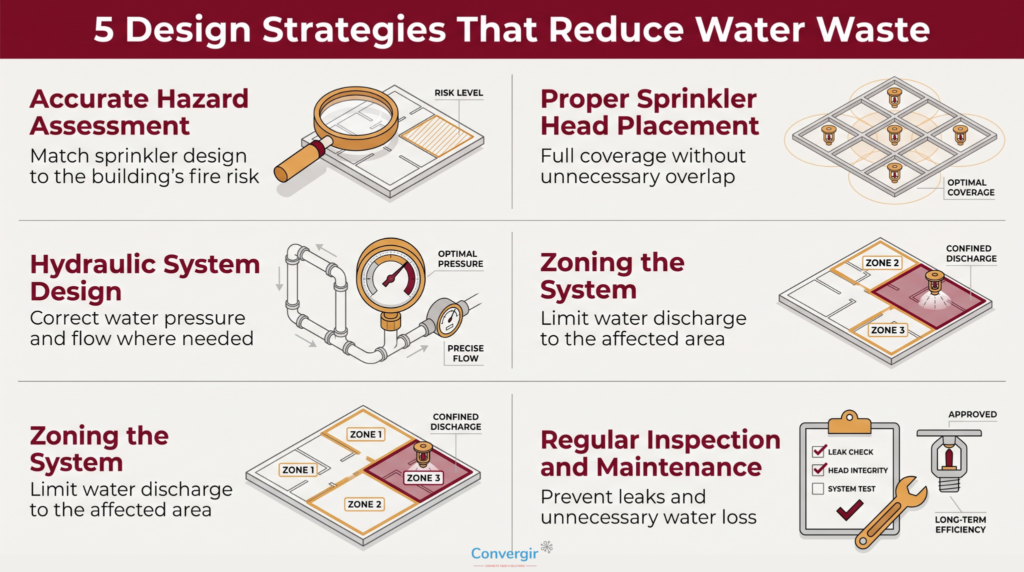
Sustainable outcomes start with design decisions that engineers make well before a system is ever installed.
Accurate Hazard Assessment
Every building has a different fire risk profile based on occupancy, materials, and use. Matching the sprinkler design to that specific hazard level ensures the system delivers exactly the protection needed, not more, not less.
Proper Sprinkler Head Placement
Careful spacing and layout planning ensure complete coverage across a space while avoiding unnecessary overlap between sprinkler heads, which can lead to excess water discharge during an activation.
Hydraulic System Design
Precise hydraulic calculations ensure the system delivers the correct water pressure and flow rate to the point of need, avoiding the inefficiency of an over- or under-designed system.
Zoning the System
Dividing a building into protection zones limits water discharge to the specific area affected by a fire, rather than triggering a broader response across unrelated parts of the building.
Regular Inspection and Maintenance
Ongoing inspection catches leaks, damaged heads, and corrosion before they cause unnecessary water loss or system failures, keeping the system both efficient and dependable.
Professional fire sprinkler system installation services play a critical role here, ensuring installation teams correctly apply these design principles on-site, from initial layout through final commissioning.
Technologies Supporting Sustainable Fire Sprinkler Systems
Modern fire protection technology has made sustainable design easier to achieve without any trade-off in safety. High-efficiency sprinkler heads now deliver effective suppression with reduced water flow requirements compared to older designs.
Smart monitoring sensors and flow monitoring devices track system performance in real time, flagging irregularities early. Leak detection technology can identify water loss from damaged piping or fittings long before it becomes visible, preventing waste that might otherwise go unnoticed for weeks.
Integration with building management systems (BMS) allows fire protection data to be monitored alongside other building operations, while digital monitoring supports predictive maintenance, flagging components that need attention before they fail. Together, these technologies make fire protection systems smarter and more resource-efficient, not less protective.
Benefits of Sustainable Fire Sprinkler System Design
A well-designed, water-efficient sprinkler system delivers benefits that extend well beyond fire suppression itself. Reduced water consumption during an incident means less secondary water damage to the building and its contents, while faster, more targeted fire control limits the scale of property loss overall.
Buildings equipped with these systems also demonstrate improved resilience, recovering more quickly after an incident. And for organizations working toward green building goals, efficient fire protection contributes directly to those objectives, while supporting long-term operational efficiency and lower lifecycle costs.
Why Professional Fire Sprinkler System Installation Matters
None of these design principles deliver their full value without correct execution. Successful sustainable fire protection depends on a thorough site assessment, accurate hydraulic calculations, careful equipment selection suited to the building’s hazard class, and strict compliance with fire safety codes and standards.
Functional testing and commissioning are equally important, confirming that the system performs exactly as designed before it’s ever needed in an emergency. This is where experienced fire sprinkler system installation and fire sprinkler system installation services make the difference between a system that merely meets code and one that performs efficiently and reliably over its full lifespan.
Conclusion
Sustainable fire sprinkler system design proves that environmental responsibility and dependable fire protection aren’t competing priorities, they work together. Through accurate hazard assessment, thoughtful system design, and the use of modern monitoring technologies, buildings can reduce water waste significantly without compromising occupant safety in any way.
Professional and experienced fire sprinkler system installation services are central to making this possible, delivering systems that are both reliable when it matters most and resource-efficient every day in between.
