A single wire break shouldn’t take down half your building’s fire protection. But whether it does, or doesn’t, comes down to one design decision made long before the system is ever switched on: Class A or Class B wiring.
Both are legitimate ways to wire a fire alarm signaling line circuit (SLC). Neither is universally “better”, the right choice depends on your building’s size, risk profile, and budget. Here’s exactly what separates them.
What “Class A” and “Class B” Actually Mean
These terms describe the wiring topology of a circuit, not the detectors or panel themselves. The difference comes down to one question: what happens to the rest of the circuit if a single wire breaks?
Class B wiring runs out from the panel to each device in sequence and simply ends, a dead-end run. If a break happens anywhere along that run, every device downstream of the break goes offline.
Class A wiring runs the same path out to the last device, then routes a second, independent wire back to the panel, completing a loop. If a break happens anywhere along the loop, the panel can still reach every device from the opposite direction.
Think of Class B as a single road into a neighborhood, and Class A as a loop road with two ways in. Block one entrance on the loop, and every house is still reachable from the other side.
How Class A Wiring Works
In a Class A loop, the circuit leaves the panel, threads through every device in sequence, and then returns to the panel along a separate physical path, usually run through a different route or conduit than the outbound wire, to reduce the chance that a single event (like fire or physical damage) could sever both legs at once.
If a break occurs anywhere on the loop, the panel detects the fault and continues communicating with every device from both directions up to the break point. No device goes offline, and the system typically still reports a trouble condition so the break can be located and repaired.
Key characteristics:
- Return path to the panel, forming a complete loop
- System stays fully functional even after a single break
- Requires more cable and more installation labor
- Common in larger, higher-occupancy, or higher-risk buildings
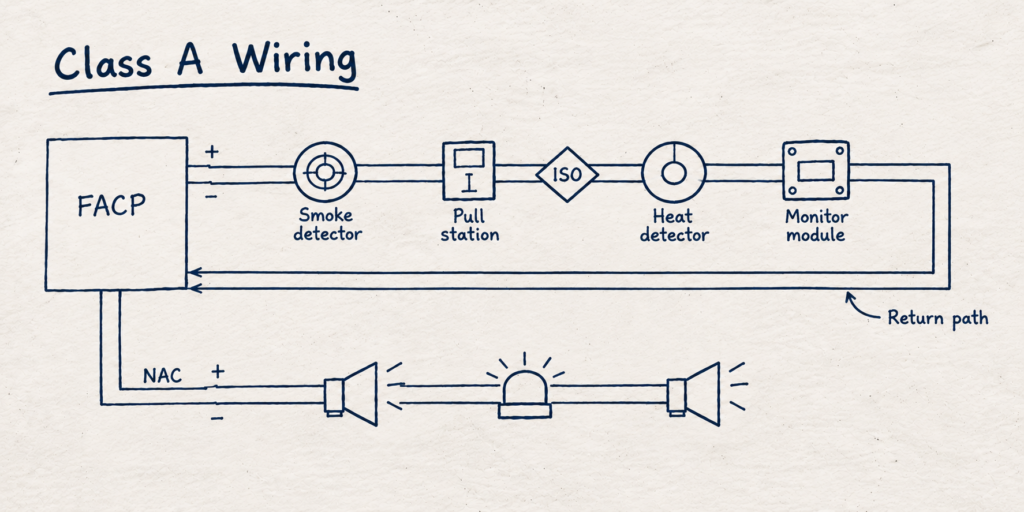
For a labeled fire alarm wiring diagram showing exactly how a Class A loop connects to detectors, modules, and the panel, see our full addressable wiring guide.
How Class B Wiring Works
In a Class B circuit, the wiring runs out from the panel to the last device and stops there, with no return path. It’s a simpler, more economical topology, but it comes with a trade-off: if a break happens anywhere along the run, every device past that point loses communication with the panel until the fault is repaired.
Key characteristics:
- Single dead-end run, no loop back to the panel
- A single break can take multiple devices offline
- Less cable, lower installation cost
- Common in smaller, lower-risk, single-zone buildings
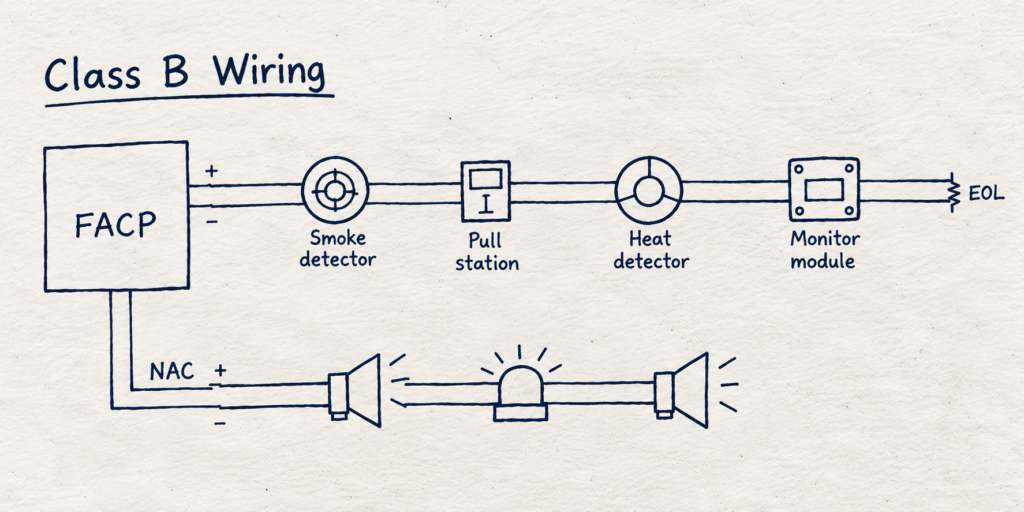
Class A vs Class B: Side-by-Side
| Feature | Class A | Class B |
|---|---|---|
| Wiring path | Loop (out and back) | Dead-end run |
| Behavior after a single break | Fully functional | Devices past the break go offline |
| Cable required | More | Less |
| Installation cost | Higher | Lower |
| Typical use case | Larger, higher-risk, multi-zone buildings | Smaller, single-zone buildings |
| Fault reporting | Immediate, with continued operation | Immediate, with partial loss of coverage |
Which One Does Your Building Need?
The right choice isn’t about which is “better” in the abstract. It’s about matching the wiring class to the building’s risk and complexity.
Class A tends to make sense for:
- Hospitals, hotels, and high-occupancy buildings
- Multi-story or multi-zone commercial facilities
- Industrial sites where a wiring fault going unnoticed carries real risk
- Any building where continuous protection during a fault condition is a priority
Class B tends to make sense for:
- Smaller commercial buildings with a single zone or a short SLC run
- Lower-risk occupancies where budget is a larger constraint
- Buildings where a prompt repair response to a reported fault is realistic
In practice, many facilities use a mix, applying Class A for high-risk or hard-to-access areas and Class B for lower-risk zones, rather than treating it as an all-or-nothing choice for the entire building.
A Common Misunderstanding
Class A and Class B describe wiring topology, not system type. Both conventional and addressable fire alarm systems can be wired as Class A or Class B, and the choice is independent of whether your system is conventional or addressable. Don’t assume an addressable system automatically means Class A wiring, or that Class B is only used with older conventional systems; the two decisions are made separately, based on the building’s actual risk and layout.
Planning Your Wiring Layout
Choosing between Class A and Class B wiring is a design decision best made during system planning, not after installation. If you’re planning a new fire alarm system or reviewing an existing wiring layout for a facility in Chennai, our team can assess your building’s layout and recommend the right wiring approach.
Every device downstream of the break loses communication with the panel until the fault is located and repaired. The panel reports a trouble condition, but coverage is reduced until the break is fixed.
Requirements vary by building type, occupancy, and local fire safety code, so there’s no single universal rule. A fire safety engineer can confirm what applies to your specific facility.
Yes, generally. The return wiring run adds material and labor cost. For larger or higher-risk buildings, that additional cost is typically weighed against the value of uninterrupted protection during a fault.
Yes, many real-world installations do exactly this, using Class A for critical or hard-to-access zones and Class B elsewhere, based on a zone-by-zone risk assessment.