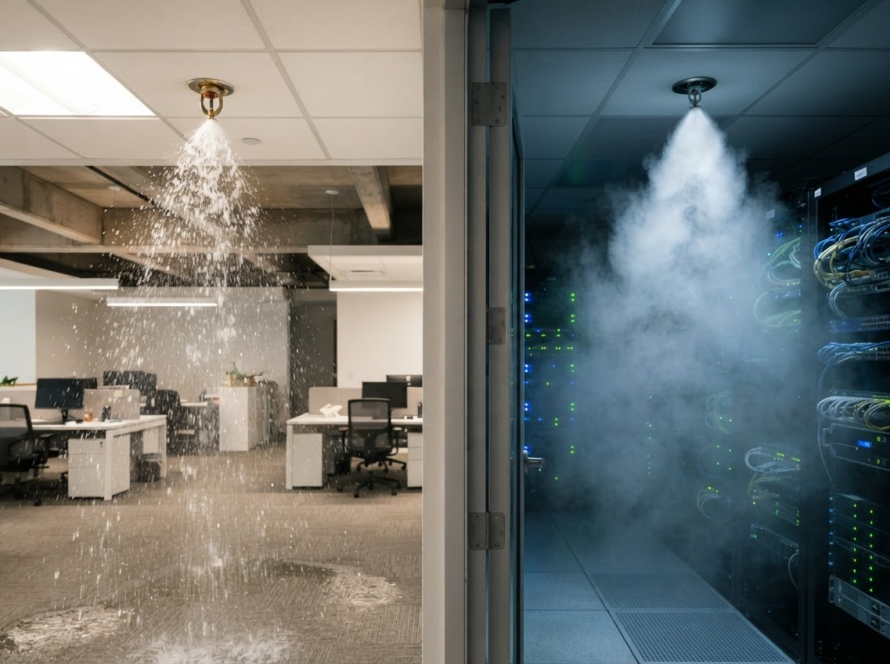
Walk into any well-run industrial facility in India today, whether it’s a cement plant, a power station, a data center, or a railway signalling room, and you’ll find fire extinguishers mounted at every corridor. They’re essential, but they were never designed to protect what actually keeps these facilities running: the electrical panels, control systems, servers, and switchgear that an extinguisher can’t reach fast enough, or shouldn’t be used on at all.
That’s the gap clean agent fire suppression systems are built to close.
The Problem With Relying on Extinguishers Alone
Portable extinguishers are a first-response tool for small, visible, accessible fires. They depend on someone being present, reacting within seconds, and reaching the right spot with the right agent. In a plant environment, none of that is guaranteed:
- LT/HT panel rooms, server racks, and switchgear cubicles are often unmanned for long stretches, especially on night shifts.
- Water and foam-based systems can short out electrical equipment, cause secondary damage, and take critical systems offline for days.
- A fire inside an enclosed panel or cabinet can built up unnoticed and escalate before a handheld extinguisher is even within reach.
For plants where downtime means lost production, lost data, or safety risk, waiting for a manual response isn’t good enough.
| Portable Extinguisher | Clean Agent Suppression | |
|---|---|---|
| Response | Manual, needs a person present | Automatic, triggers on detection |
| Best for | Visible, accessible fires | Enclosed panels, unmanned rooms |
| Electrical safety | Water/foam types risk damage | No residue, safe on live equipment |
| Speed | Depends on human reaction time | Reaches extinguishing concentration in seconds |
| Downtime after use | Cleanup often needed | Back online almost immediately |
| Occupied spaces | Always safe | Safe at design concentration (unlike CO2) |
What Clean Agent Fire Suppression Actually Does
Clean agent suppression systems, typically using agents like FM-200 (HFC-227ea), Novec 1230 (FK-5-1-12), or inert gas blends, are engineered for exactly these scenarios. Unlike water or foam, they extinguish fire by rapidly absorbing heat and reducing oxygen concentration around the fire, without leaving behind residue, moisture, or conductive material.
That means:
- No damage to electrical or electronic equipment: critical for panel rooms, data centers, and control rooms.
- Fast total flooding: extinguishing concentration is reached within seconds of discharge, far faster than a person could respond with a handheld unit.
- Safe for occupied spaces: designed for concentrations safe for personnel, unlike CO2 flooding systems.
- No cleanup, no downtime for decontamination: plants are back online almost immediately after discharge.
These systems are engineered and installed to NFPA 2001, the global standard for clean agent fire suppression, alongside Indian fire safety codes for special hazard protection, exactly the kind of compliance industrial clients, insurers, and auditors expect to see documented.
Where Industrial Plants Actually Need This
Clean agent suppression is standard practice, not optional, at the sites where fires cause the most operational and financial damage:
- LT/HT electrical panel rooms in cement, power, and process plants
- Server rooms and data centers, where even a small fire can mean total data loss
- Railway and metro signalling and relay rooms, where downtime affects safety-critical operations
- Control rooms and SCADA rooms in oil & gas and power generation facilities
- Switchgear rooms and transformer bays in industrial and utility installations
In each case, the asset at risk isn’t just physical property. It’s uptime, safety, and continuity of operations that a plant can’t afford to lose.
Extinguishers and Suppression Systems Work Together, Not Instead of Each Other
This isn’t an either/or decision. A complete fire safety strategy for an industrial facility layers multiple systems:
- Detection: early warning through smoke and heat detection before a fire spreads
- Portable extinguishers: for visible, accessible, human-attended fires
- Clean agent or gas suppression: for enclosed, high-value, electrically sensitive spaces
- Fire alarm and hydrant systems: for building-wide coverage and larger fire events
Treating extinguishers as the only line of defence leaves the most critical, highest-value spaces in a plant under-protected. The right approach matches the suppression method to each space’s actual risk profile, starting with a proper site assessment, not a generic checklist.
Getting It Right Starts With the Right Design
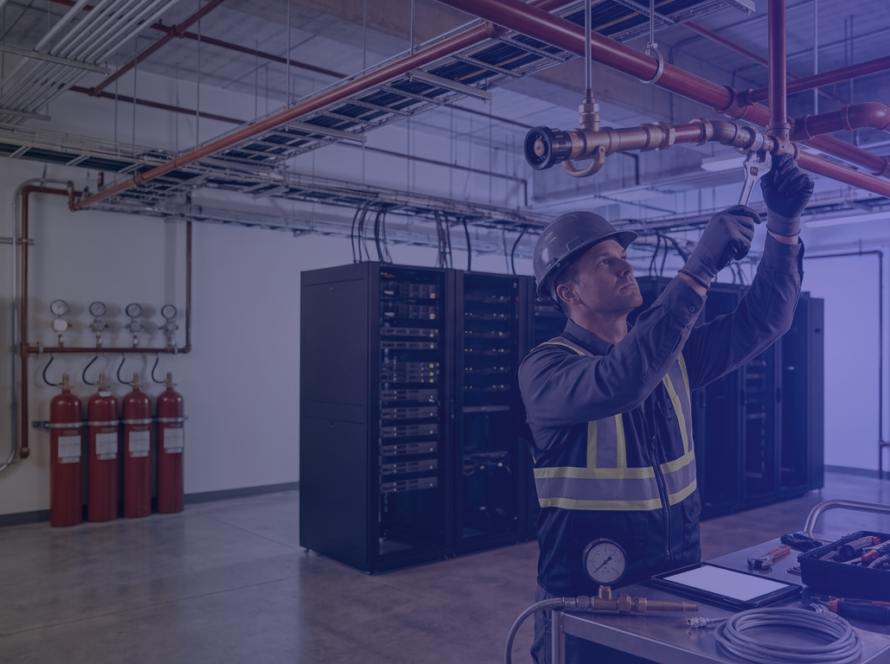
Clean agent suppression isn’t a plug-and-play purchase. It needs correct agent selection, room integrity testing, discharge time calculations, and integration with your existing fire detection and alarm systems. Done wrong, a system either under-protects the space or triggers unnecessary shutdowns.
At Convergir Techno Systems, this is exactly the kind of work we do end-to-end: site inspection, system design, supply and installation, and ongoing testing, commissioning, and AMC support for clean agent panel flooding and aerosol suppression systems across industrial, commercial, and critical infrastructure sites, including LT panel rooms, server rooms, railway signalling installations, and process plants across India.
If your facility still relies solely on extinguishers to protect its most critical spaces, it’s worth a proper site assessment to see where the gaps are.
Talk to our experts to get a fire risk assessment for your facility.